time zone will be applied.
Report this post?
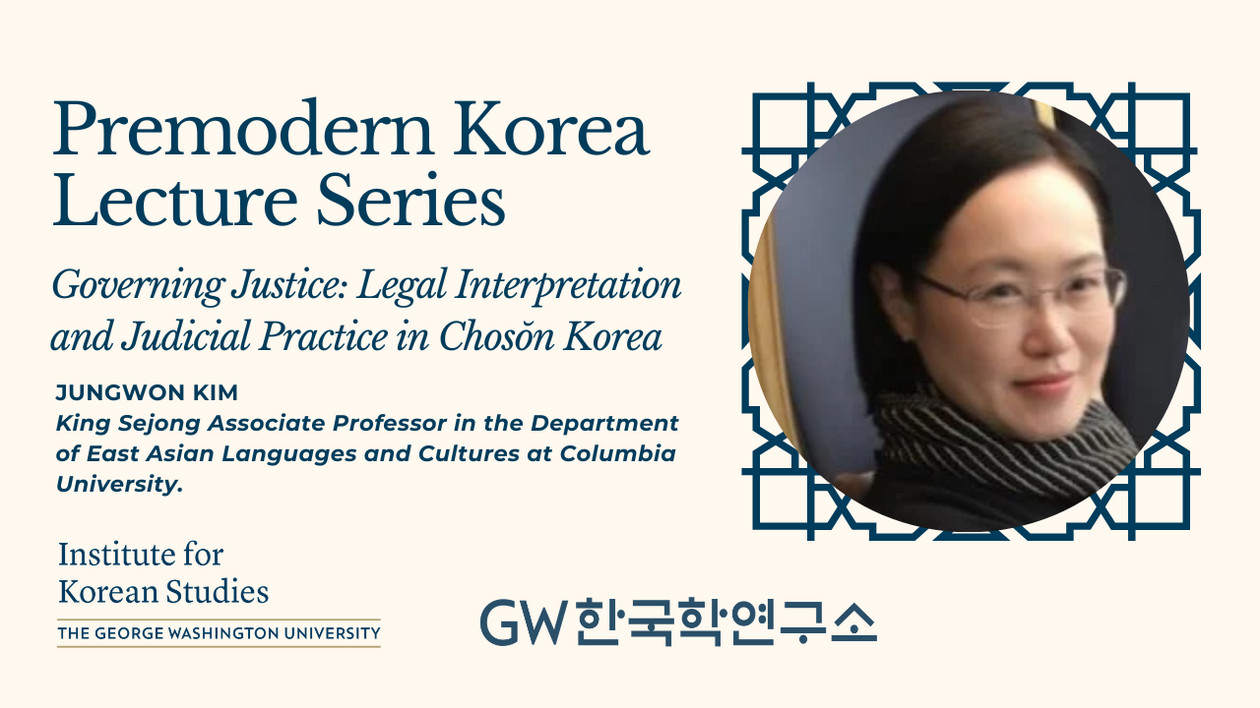
Event Description
This talk explores the role of legal knowledge, particularly the expertise of specialized legal officers, in shaping judicial practice in Chosŏn Korea. These officers constituted a distinct category of legal expertise within the bureaucratic hierarchy, differentiated from Confucian scholar officials by formal legal training and technical authority. Institutionalized through specialized examinations in law, they occupied a pivotal position in assisting local magistrates in adjudication and guiding judicial interpretation and decision making. Drawing on an array of archival sources, including law codes, legal commentaries, trial records, and evaluations of official performance, the talk traces how these specialists were trained, how they exercised authority in local courts, and how their work was supervised and assessed. By centering these often overlooked figures, the talk illuminates the intricacies of legal interpretation in practice and considers how evolving forms of expertise and legal literacy influenced judicial decisions at the local level while informing the relationship between technical knowledge, judicial authority, and the pursuit of justice in Chosŏn Korea.
Jungwon Kim
Jungwon Kim is King Sejong Associate Professor in the Department of East Asian Languages and Cultures at Columbia University. A historian of premodern Korea with a particular focus on the Chosŏn dynasty (1392–1910), her research examines gender and sexuality, law and justice, crime and punishment, ritual and emotion, women’s writing, and the history of knowledge. She is the author of Virtue That Matters: Chastity Culture and Social Power in Chosŏn Korea, 1392–1910 (Harvard University Asia Center, 2025). Her other publications include co-authoring Wrongful Death: Selected Inquest Records from Nineteenth-Century Korea (University of Washington Press, 2014) and co-editing Beyond Death: The Politics of Suicide and Martyrdom in Korea (University of Washington Press, 2019). She also edited the special issue “Archives, Archival Practices, and the Writing of History in Premodern Korea” in the Journal of Korean Studies (2019). She is currently working on a book manuscript tentatively titled Families in Trials: Local Courts and Legal Culture in Chosŏn Korea. She received her PhD from Harvard University.
Jisoo Kim
Jisoo M. Kim is Korea Foundation Associate Professor of History, International Affairs, and East Asian Languages and Literatures at George Washington University. She specializes in gender, sexuality, law, justice, emotions, and affect in Korean history. Kim penned the award-winning book The Emotions of Justice: Gender, Status, and Legal Performance in Chosŏn Korea (2015), coedited JaHyun Kim Haboush’s posthumous book The Great East Asian War and the Birth of the Korean Nation (2016, coedited with William Haboush), and edited Emotions, Affect, and Narrative in Korean History and Culture (April 2026). She is currently completing a book manuscript on the history of marriage and adultery law in South Korea. This book project was supported by the Harvard Radcliffe Institute for Advanced Study Fellowship (2024–25). She was the founding director of the GW Institute for Korean Studies (2017–24) and the founding co-director of the East Asia National Resource Center (2018–24). She served as the editor-in-chief of the Journal of Korean Studies (2019–25).