time zone will be applied.
Report this post?
DATE: Tuesday. May 12, 2026. 7:20PM (Seoul)
VENUE: Seoul Public Activities Center (SPAC, 서울시공익활동지원센터). ‘다목적홀’
(ADDRESS: Basement Floor, 40 Baekbeomro 99-gil, Yongsan Verdium Friends(용산베르디움프렌즈) #101, Yongsan-gu, Seoul), 2-3 minutes walking from Exit 8 of Samgakji-Station (Line 6 & Line 4)
SUMMARY:
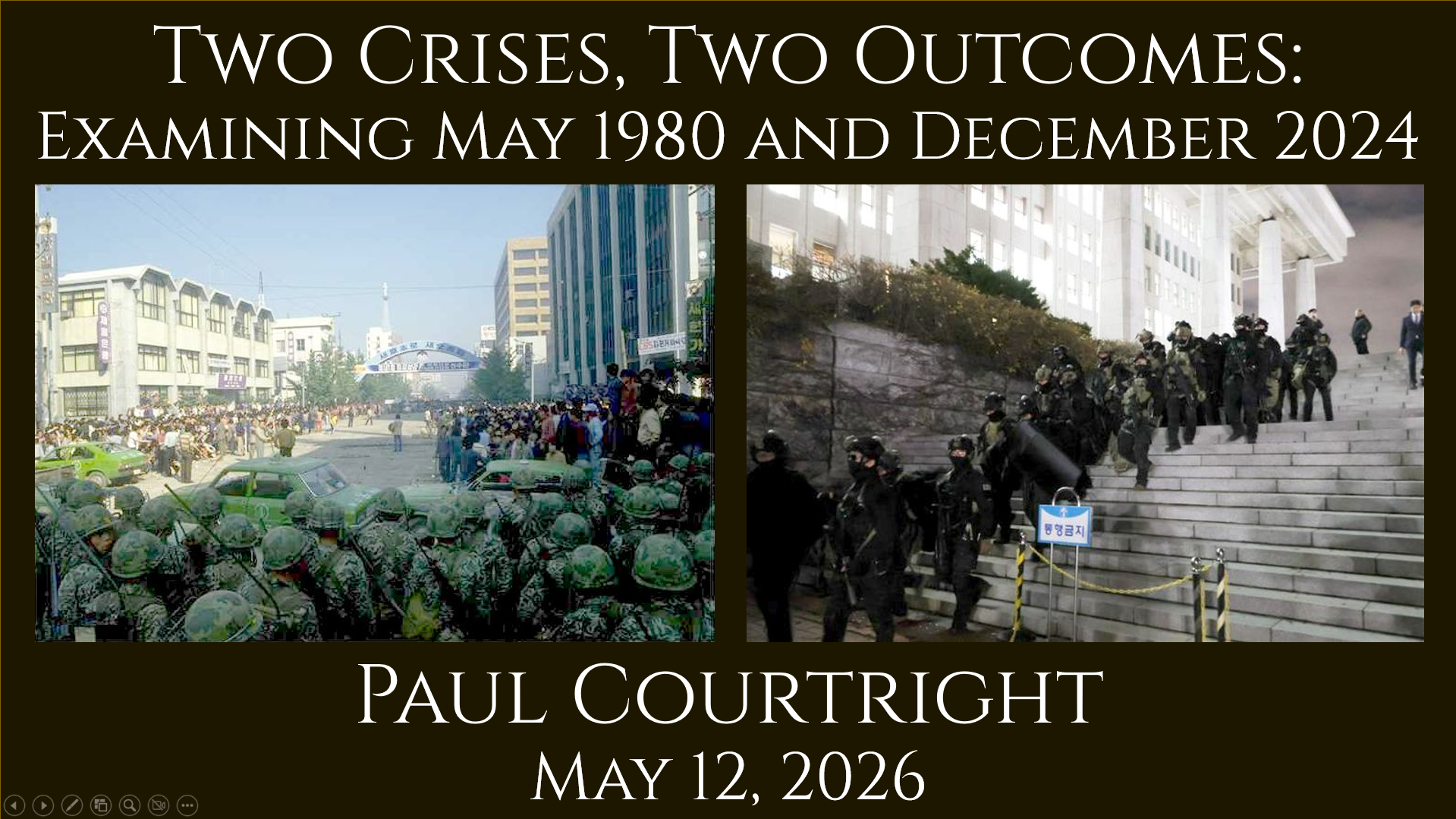
On December 12, 1979, amid the power vacuum following Park Chung-hee’s assassination, Major General Chun Doo-hwan seized control of the military by arresting the ROK Army Chief of Staff and pressuring President Choi Kyu-ha to retroactively approve the move. Over the following months, he carried out a “rolling coup,” consolidating power within the armed forces and assuming leadership of the Korean Central Intelligence Agency. This process culminated in the aftermath of massive student demonstrations in May 1980, when he expanded martial law nationwide, ordered the closure of universities and the National Assembly, and arrested opposition politicians. When citizens in Gwangju rose in protest, the military’s violent suppression of the uprising – resulting in hundreds of deaths – crushed organized resistance and cemented his faction’s hold on power, paving the way for his indirect election as president under a new constitution crafted under his direction. After successful pro-democracy demonstrations in 1987 led to the reinstatement of direct presidential elections, martial law declarations seemed a thing of the past.
45 years after Chun’s coup, on December 3, 2024, President Yoon Seok-yeol declared martial law, arguing it was necessary to break legislative deadlock, suppress what he characterized as destabilizing opposition activity, and restore state authority. The martial law order collapsed within hours as thousands of citizens gathered outside the National Assembly in defiance, confronting troops, blocking access, and creating the conditions for lawmakers to enter and vote down the decree. In a decision upheld by the Constitutional Court, the National Assembly subsequently impeached Yoon on charges including unconstitutional declaration of martial law without a qualifying national emergency, violation of civilian control over the military, and abuse of executive power.
For this lecture, Paul Courtright, who witnessed the Gwangju Democratization Movement and wrote the book “Witnessing Gwangju” (2020), will briefly share his perspectives on 1980 and 2024, drawing out lessons from both events and relating them to the current American political context. This will be followed by an interactive discussion exploring common themes, points of comparison and contrast, and what broader lessons these events may hold for the international community.
BIO:
Paul Courtright was a US Peace Corps Volunteer in Jeonnam Province of Korea from 1979-81. He completed his Masters and Doctorate in Public Health focusing on eye diseases and neglected tropical diseases. For 20 years he lived and worked in Egypt, Ethiopia, South Africa, and Tanzania establishing, with his wife, the Kilimanjaro Centre for Community Ophthalmology in Moshi, Tanzania. He has published over 275 scientific articles and has received awards from the American Academy of Ophthalmology, the Premio Vision Mundi de Lucha Contra la Cuguera, and the Antonio Champalimaud Vision Award. He is also a professor (adjunct) at the University of Cape Town. He is married with two sons and currently lives in San Diego. Since 1981 he had continued his relationship with Korea conducting research there with Korean colleagues and is on the Board of Friends of Korea.
He previously lectured for RAS Korea about his experiences in Gwangju in 1980 and about the responses he received to the publication of his book.
ADMISSION (Online & In-person): Free for RAS Korea Lifetime and Annual Members; W10,000 for Non-members; W5,000 for Non-member students (Student ID requested)
VENUE:
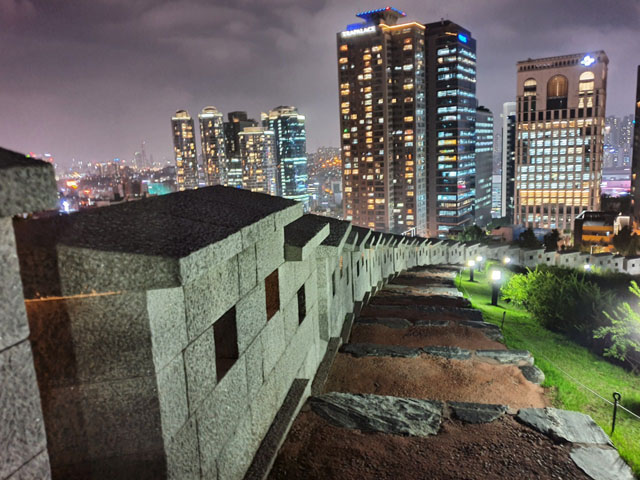
The Seoul Public Activities Center(SPAC, 서울시공익활동지원센터) is located at Yongsan Verdium Friends #101 (용산베르디움프렌즈 101동) B1, 40 Baekbeomro 99-gil, Yongsan-gu, Seoul. Walk 2-3 minutes from ‘Exit 8’ of Samgakji Station (LINE 6 & 4) and take the elevator down to the B1 Floor.