time zone will be applied.
Report this post?
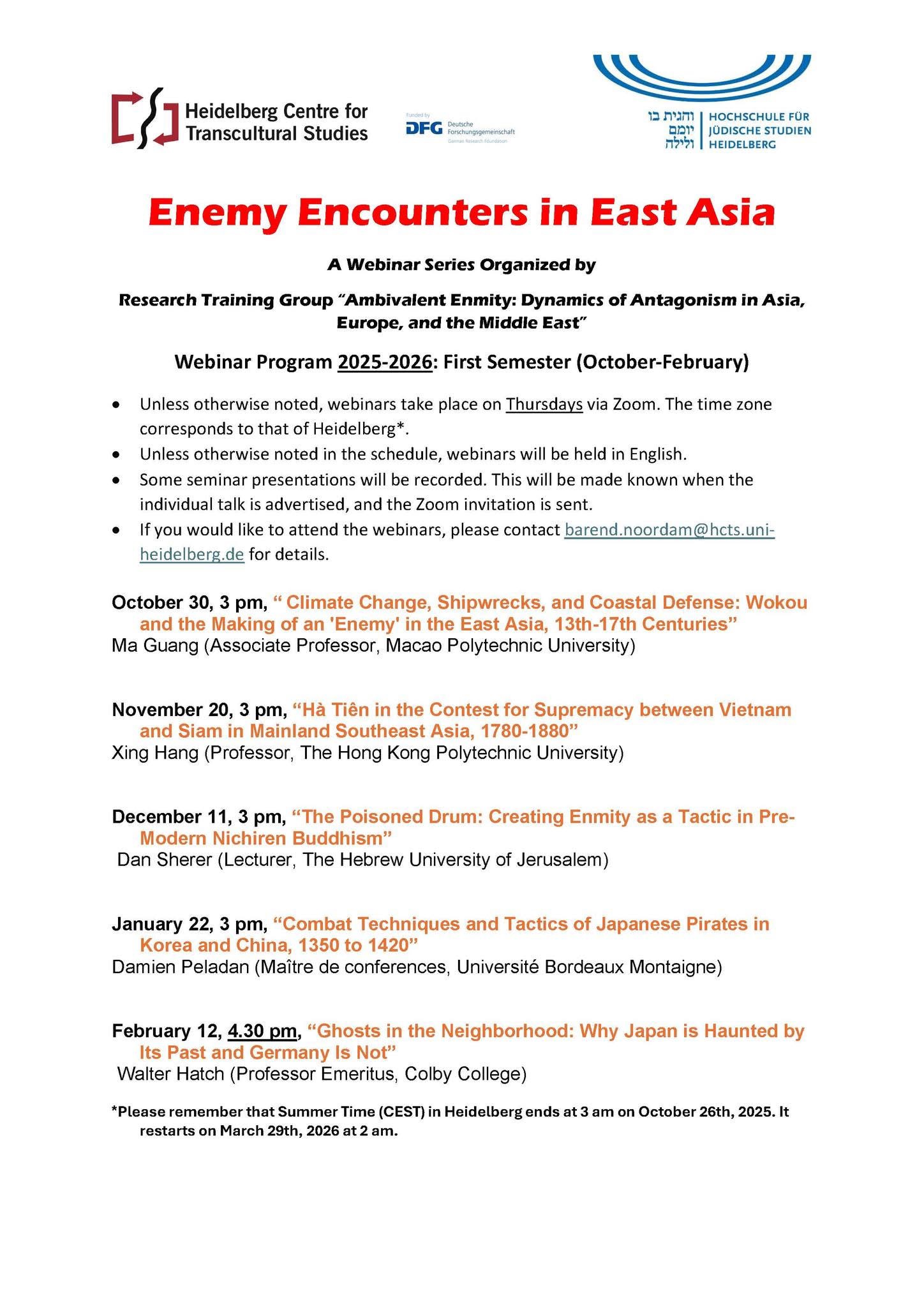
Enemy Encounters in East Asia webinar series for the first semester of the 2025-2026 academic year.
The webinar is organized as part of the Research Training Group (RTG) Ambivalent Enmity: Dynamics of Antagonism in Asia, Europe, and the Middle East, hosted by Heidelberg University and the Heidelberg University of Jewish Studies.
If you are interested in attending the webinars, please send an email to Dr. Barend Noordam (barend.noordam@hcts.uni-heidelberg.de) to register and you will receive the regular webinar invitations to the sessions. If you have registered for previous webinars there is no need to register again.
In this session, Damien Peladan (Maître de conferences, Université Bordeaux Montaigne) will share his thoughts on warfare during the waves of Japanese piracy in Korea and China between 1350 and 1419:
Between 1350 and 1419, the coastlines of Korea and China became frequent targets of pirate fleets operating from the Japanese archipelago. Known in contemporary scholarship as “Japanese pillagers” 倭寇(Ch. wokou, Jap. wakō, Kor. waegu), these fleets—sometimes numbering dozens or even hundreds of ships and comprising thousands of individuals—became the scourge of Chinese and Korean coastal populations, as entire communities were repeatedly massacred or carried off into captivity.
In response, Chinese imperial and Korean royal forces sought to repel these incursions, both at sea and on land, with varying degrees of success, as the pirates often demonstrated considerable military proficiency. This presentation examines the range of tactics and fighting techniques employed by pirate groups when confronting Korean—and, to a lesser extent, Chinese—armies. As will be shown, although guerrilla warfare predominated for much of the period, characterized by the skillful use of deception and subterfuge, pirate forces were at times capable of matching official armies in open engagements, both on land and at sea. A central aim of this study is to trace the evolution of these tactics over time and to analyze how state authorities adapted their responses accordingly.
The video recordings of previous webinars are available online on the YouTube channel of Heidelberg University.